Wednesday, November 25, 2009

Thanksgiving Eve

I took part in the wonderful American tradition of the multi-state, headed-home-for-Thanksgiving road trip today.

I heard the president pardon the turkey while listening to radio news over-intently--with millions of others--for the East Coast traffic reports.


View Larger Map


I shotgunned a fast-food egg while discussing the suspicious origin of the moniker "English Muffin," as many have before.

I suffered from heartburn (see fast-food egg), an acute case of ultra-stuffed pockets, heel-itis, GPS hate, eye-death, brain-stall, restless leg, and restless spouse (see traffic).

Out there on the roads today we all felt (all 33 million of us) some strange civic unity (positive), and we all--over-tired and bumper-to-bumper--wondered if the true point of Thanksgiving is to consider the derivative nature of human experience (negative), an experience which--bleared by rained-on headlights--seems easy to be ungrateful for.

Headed in the same direction, at 1 mph, with everyone else and his uncle (on the way to his other uncle's house) makes us feel, maybe, like we're out of control of our own lives. In fact, the 19th century writer Charles Lamb--in his essay "New Year's Eve"--went further (even though he lived pre-traffic jam):

"Whatsoever thwarts, or puts me out of my way, brings death into my mind. All partial evils, like humours, run into that capital plague-sore."


I've always thought that was a wonderful description for why some of us get so upset about trifles--we shortcut from slight annoyance straight toward that eternal no-right-on-red.

But, lo, the traffic jam ends. And whatsoever doesn't thwart me--homecomings, well-timed cups of tea, the cessation of spousestration--puts me in mind of what I have to be thankful about: marriage, family, and the La Quinta Inn of Harrisburg P-A (our half-way stop).

But let's see if I feel this good on Sunday, at hour fourteen, at a red light, Ohio-bound and bleary.

Tuesday, November 24, 2009

Bolt

Last night, our friend's daughter, Ruby, invited Megan and me to her fifth birthday party, which will be in March. She told us that there'll be millions of kids there and then looked around the room, saw her mom and dad and me and Megan, and counted to four.

"A million kids and four parents," she said.

This was an advance for Ruby. A few months ago, she said to Megan about the kids' movie Bolt, "You shouldn't watch it until you're a mommy. It's pretty scary." I'm not allowed to see it either, it turns out. This led Megan to think that Ruby considered us contemporaries of hers, and that, since we didn't have kids, we, too, must be four years old.

Suddenly, we've aged at least two decades in her eyes and her declaration was a big moment for me personally. I've been called a "man" before by little kids, but this was the first time I've been considered daddy-material.

When I got married in August and declared in church that I was willing to be such a dad, it should have hit home, but it didn't really. That seemed official, spiritual, theoretical. Plus, I still feel in many ways like a kid, and dads are not, in my experience, kids. In fact, I'm not sure my own father ever was one. I imagine he came out of the womb looking something like this:

(Doctors were amazed by the pre-natal spectacles he'd developed)


Still, I'm trying to grow into the idea of myself as a pop by slowly learning what kinds of foods are dangerous for little ones, how many times a day they defecate, whether they can be safely held upside-down during leap year, and so on.

And I've been trying to imagine what I'll feel if I find out I'm about to have a kiddo. I think I'll bust out with a rendition of "Down on the Corner" by Creedence. It's a pretty happy tune. And I'd like my child to learn rhythm early in life. Maybe then I'd set up a game of cribbage and loudly go over the rules; I want my kid to be good at board games, after all, and this could be a solid start.

As long as he/she's healthy (and awesome at puns).

After the high-fives and hugs, though, after Megan's gone to sleep, I'll put myself on trial for the next 8 hours, 8 months. I have a lot of verve to pass on, but a lot of neuroses, too. Can I temper that stuff so that Wanczyk Jr. doesn't (for instance) chomp on his fingernails like they're ears of corn?

Basically, I'd like to carefully hone what this little person will inherit from me. And though that's probably out of my control, I'm glad I have a little time. For now, I can be me without having, toddling around, a be-diapered mirror in which I see myself.

I would really like to see Bolt someday pretty soon, though. I think I'm going to love it. But I'll bet it's even scarier than Ruby says.

Vindication

Monday, November 23, 2009

Show-Stoppers

Here's a premise for an old-timey showtune: emotions are primary colors.

There are some basic emotions--like red, yellow, and blue--that mix to form the rest.

Love and hate are on the palette, and melancholy too. Love mixes with hate to form envy; melancholy with hate to form shame; and different amounts of love-paint and melancholy-tint come together to create just about every other sensation on the spectrum.

The song might go something like this:

You've got me feeling all yella-green
and ev'ry color that makes me live.
You're all kinds-a shades I've never seen.
And in my heart. . .you're. . .Roy. . .G. . .Biv.


(Verse two rhymes "Schenectady" with "Tweedle-dee-dee," naturally).

This is all to say that I sometimes feel an emotion, when watching a great performance, that I'd like to dub "Gene Kelly Green." It's somewhere far-east of envy, but it's not quite unadulterated love.

See, Gene Kelly is my all-time favorite performer. Whenever I see him tap-dance, croon, and pick-up ladies in 1950s Paris, I feel uplifted. But I wish, for a small second, that I could be just as much of a show-stopper.


(Pardon the lyrics of this song, which may be--somehow--worse than those recorded above!)


I don't feel jealous--I'm always smiling--but I do feel nostalgic, almost, admiring what and how much people can be.

I felt Gene Kelly Green last weekend watching Joseph Gordon-Levitt on Saturday Night Live. To my great consternation, I can't show you what incited that feeling because the online video has been confiscated; but suffice it to say it's the only thing that has ever made me give my television set a standing ovation.

Here's hoping I can scrawl something down someday that gets me out of my own chair. Right now, I'm stuck, as usual, spinning my roller-skate wheels, trying to come up with a jazzier ending.

Sunday, November 22, 2009

A Bite-sized Memoriam

Today, Megan and I had an impromptu lunch with our downstairs neighbor, a 91-year-old widow whom we call Mrs. DeLott. (As for her first name, we don't know it. We've heard her called Coletta, Helen, and, just now, Lovey.)

Today, Megan and I had an impromptu lunch with Lovey DeLott and her friend Ruth. We'd brought Lovey/Coletta (noir-ish, either way) some cookies to say 'Happy Thanksgiving,' and she insisted us in, offering sweet-old-lady sandwiches made on bite-sized rolls (you know the ones).

We talked about potato salad, Connecticut, her husband--"that sweet man"--and a new brand of food-container we all love (Snapperware). The conversation was delightful. It was friendly and predicated on roast beef--my second favorite kind of conversation, really, only bested by ones riddled with wordplay and electrified by Trivial Pursuit.

And there was something nice, today, about speaking louder than I normally would. Oftentimes that can be hard with the elderly, but this afternoon I liked being resonant!


Lovey (that's Mrs. Lovey, to me) had laid out too much food for her and Ruth, and so when Megan and I came in, she immediately wanted us to help them with it. I obliged, as I always do when presented with such a lucky task. My own grandmother thought I was the family Hoover and consistently tested the limits of my stomach's capacity with kielbasa and homemade pickles. I loved when she gave me the excuse to make gluttony a virtue.

"Eat all of that for me, David," Mrs. Lovey said, pointing to four coldcuts (rolled in the sweet-old-lady way) and a slice of sharp cheddar. My grandma used to say the same sort of thing to me. Making me eat was her way of knowing she'd cared for me. She could see that care, kindly prepared, disappear off the plate and into my maw.

I knew it meant something to her to see me clean my plate, twice. And I felt the same way today with another 91-year old widow who wanted to care for me--"Eat, eat"--and wasn't quite sure how else to do it.

Saturday, November 21, 2009

The Fight

Amanda Spituvnik leered at me as this kid named Josh held me against some bricks by the foursquare court. (I've found that I don't always get along with Joshes, Jeffs, and Jareds.)

“Why did you kick me?” Josh demanded. See, he'd tackled me right after class got out and I'd nudged him with my foot to get him off of me. My fighting back had brought on what I've since dubbed The Foursquare Fight.


Sometimes kids went down to the CVS parking lot to figure this sort of thing out. But I was on the Geography Team and my mom picked me up from school, so I didn't think much about settling scores.

Then this. Amanda Spituvnik leered at me. She must have been 5'8” in the fifth grade. I hated her.

“Why did you kick me?” Josh demanded again.

“I didn't.”

I didn't,” Amanda parroted in a high voice that was, I suppose, making fun of the fact that my balls hadn't yet dropped. She was Vice-Principal Mrs. Spituvnik's daughter and had convinced everyone she was a good-kid.

Even though she must have looked like a good, little girl at the time, in my mind she's still one-part Courteney Cox, one-part Leona Helmsley, one-part fully-adult insolence.


And so it's important that I repeat her full name. Bullying will out! Recompense shall be mine, Amanda Spituvnik. Note: some names have been changed.

“Do you wanna fight?” (Josh may have been “dating” A. Spituvnik, and they made a formidable team. He had orange-peel hair and wore Ricky Rudd t-shirts.)

“No.”

No,” she repeated Spituvnikly and spitefully. She is a terrible, terrible person. She is wearing red. Was, I suppose.

I'm realizing now that some things about my personality and my actions--the “I supposes,” the Geography, the complete innocence surrounding body parts (jokes thereof and pertaining to), the fact that during recess football I always picked Matt Kelvis instead of Chad Funderwald (a hard-nosed, 3'11” Josh-sympathizer), my blushing crush on fellow goody-two-shoes and floutist Laura Westbrook (a rival of The Spituvnik's for prime brunette)--probably brought this hassling on.

And so now it had come to pass. Josh jerked me away from the brick and wrestled me around. His Starter jacket added bulk but not agility.


Meanwhile, my backpack, with ruler and colored pencils, gave me some key armor. I held my own!

First, some pre-bout background:

Earlier in the day--during a lesson led by the awkwardly beautiful Miss Auchy, our student teacher and the only person I've ever known who went to Franklin Pierce College (“We Polked you in 1844, we shall Pierce you in 1852”)--Josh had shouted to the class, “What David, you want to kiss Miss Auchy?”

I may have hinted that, yes, but Josh's tactlessness was way out of line. I shot him a fighting glance. That led, I think, to his post-class tackle of me, to my kick, to the bricks, to The Spituvnik.

Josh and I fought 2 rounds, 7 seconds each.

He grabbed my bagstraps and jacket.

My attempt to seize his slippery-puff coat eventually succeeded.

He'd gained a distinct advantage.

We drove each others' shoulders like steering wheels, at ten and two.

The Spituvnik's disembodied head circled mine.

It mocked me and my Laura-like. "Who do you love more? Laura or Miss Auchy," taunted the head.

Josh kicked my left calf and my red sweatpants offered no protection.


Round two.

We re-engaged and he swung.

I lost my balance trying to deliver a defensive response, but held fast to his jacket--Charlotte Hornets.

He jerked me back up.

I thought about what I'd learned from football and went for his legs, unsuccessfully.

He struck me in the ribs.

“Trip him,” Spituvnik directed with a sadistic calm.

He released, and leg-whipped, and the leg-whip landed. End of round two.

With my arms ferris-wheeling, I fell, as if from an inner-tube, into some dirty snow. I walked away wounded toward Union St., which I'd always misread as Onion, toward my mom's salt-caked minivan, which had newly arrived.

Just. . . walk. . . away,” Amanda said, quoting the Drug Abuse Resistance Education (D.A.R.E.) mantra we'd learned that day from a kind policeman. She, I'd decided, was mean.

This was my only fight. I'd had strong competition--a toughie and his goading girlfriend. I didn't do very well.


There was a bright spot, though. I may have inadvertently broken Josh's nose with my backwards-flailing-combination: he missed school the next two days. But it's possible he was just suspended. Had a teacher seen the fracas? Had The Spituvnik ratted on her fighter to save her own skin? Was Josh merely a victim of her deceitful plea-bargaining with her mother, the vice-principal?

Probably. Either way, I didn't tattle, which means more on the schoolyard than it should. Josh and I had a tense friendship after that.

I think we considered the donnybrook a draw. My final record: 0-0-1. No KO's.

***

When I was 12, a sixth grade Jeff, with orange-peel hair and a Guns 'n Roses t-shirt, lifted my heavy backpack over my head until I had to run forward. Then, dropping it, he whip-lashed me out of wanting dinner that day. No one ever stripped me of my undefeated status, though.

And the floutist, L. Westbrook, ended up liking me for a short time--or so a phone call she placed from a slumber party would have me believe.

So, even though that pre-adolescent romance also ended in a draw, eat it Spituvnik.

Friday, November 20, 2009

Coaching

Today at noon, I finished teaching my sixteenth class. It's been five years and some change since I walked into my first, and I still remember the pounding nervousness of standing in the hall beforehand rehearsing my opening joke. At 22, armed with a hastily-constructed syllabus, I figured I had little else to offer my freshman students.
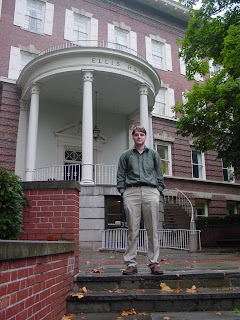

(First day of school, 2oo4. I don't seem to have grown into my feet at this point.)

I paced, crossed myself, spurted out a Hail Mary, and went in. The two dozen hooligans that made up my first group looked so old to me, reinforcing my feeling that I was not grown-up enough to be their instructor. They all had the attitude of Catholic School girls who'd just been smoking in the stairwell--even the guys. It was only their first college class, but they already slouched, cynically. It's hard to say who was more uncomfortable, them or me.

The room smelled like radiator heat and spearmint. I forged ahead.

Even now, walking into a classroom for the first time feels like a strange sort of blind date--with 20 people. I try to be charming. They look at me suspiciously. I ask them about themselves. And they, having expected someone different--an animated older woman with skunk-spot hair and a deep knowledge of Shelley, for instance--know that they just have to get through it.

Teachers, like actors, share an adage about that opening-night/opening-class feeling. If you ever lose the butterflies, they say, you know you're in the wrong profession. Based on that conventional wisdom (and the turmoil of my stomach), it seemed as though, on that first day in September 2004, I'd found my true calling.

I pulled out the roster with all their names so I could take attendance. The time had come for the joke that would win them all over. As I took roll, I said, after a dramatic pause, "Okay, let's get rolling."

The laughs were, as you can imagine, not forthcoming. And now the scripted part of my show was totally exhausted!

I blundered forward, in blue blazer, embarrassed. As I trembled through the calling of their names, I felt my credibility dissipate further.

There was some noticeable tittering.

I had them interview themselves in order to buy a little bit of prep-time (nothing like group work to take the pressure off teacher). I wrote "WANCZYK" on the board, breaking the chalk, and sat down.


In huge letters, I scrawled, "THAT WAS CRAZY" in my notebook. I figured if I looked like a loose cannon it might distract them from my general unreadiness, so I muttered to myself. I was like a pitcher who's purposefully wild when warming up just to scare the opposing hitters.

As I took the teaching-mound again, though, I had trouble throwing strikes.

The class was called Writing and Rhetoric 1--in other words, the subject was How to Think. I certainly hadn't mastered that myself, so mostly we talked about books and about their weekends. I determined that my teaching style was something I called "Energy Theory." As long as I was excited, they'd be excited.

Sometimes this worked. Often not.

One day, I asked a question about an essay they'd had to read and, taking my cue from a veteran teacher, waited as long as I could for a response.

"How do you think the structure of this piece works? What's the writer trying to accomplish?"

We sat silent for six minutes. They held their ground. I looked at each one of them imploringly. They folded their arms. There was some noticeable tittering. I grew a zit.


"Ok, then. Let's take a break."

A pop quiz helped me save some face, but they'd earned an early dismissal with their courage.

The next class, I tried to throw a kid out of class for goofing before we'd even gotten started. Marty Gertz. "Get out, Marty," I said. "Get out now." (I'd planned this bad-copping in advance to get some respect back). He apologized and I let him stay. I always do. "Okay, let's get rolling, then," I said.

Later in the term, some of the guys took to calling me "coach," which was mostly insulting but better than nothing. We worked hard on their compulsory papers about social issues. I tried to get them to punctuate correctly; many of them did. There were fewer silences, some laughs, and I didn't have to threaten anyone again. In that class, I claimed very small victories.

I still do. Teaching is a strange job because its benefits are long-term and mostly intangible. I can't know if my students actually think more acutely after they're through with my class. If they remember any of the scenes from the books we've pored over. If they've changed at all.

There's no widget at the end of the assembly line, no healed wound, no million bucks in the bank.

Sometimes I don't even know what my end product is supposed to be.


Early in my career, I had a similar crisis. I was droning on and on before I finally said to my students, “If any of what I'm saying is making you like writing or reading less, then I'm sorry. That's the exact opposite of what I want.”

And I do want them to like these things. But can sharing that enjoyment be a life's calling? Sometimes I'm not sure. I do know I was thrown off-course for the better by English teachers and that I would like to do that for my students.

Now that I teach personal writing, though, that task seems even harder. I say, "Be Honest, idiosyncratic, over-analytical, self-reflective." Sometimes I worry I'm trying to teach them to be me. And while I wouldn't mind if the college offered a minor in Wanczyk, I don't think I'm necessarily the role model who will nudge them toward a productively off-kilter life.

Then again, if one guy starts thinking he likes school because I do PR for knowledge, because I'm an oddball, maybe he starts believing he wants to learn more, be odd, maybe he writes the world's best sentence (something like Keats's "Hedge-crickets sing"), complete with spondees and perfectly-placed hyphens and concise, ecstatic revelation: maybe he feels fulfilled, gets the girl, makes the world--at least his--more tolerable.


If he keeps writing long enough, I remind him, he'll surprise himself. That would be good. It's worth a try, at least.

As a coach, that's the answer I'm looking for. So I keep asking the question, I guess, even though I might have to wait six minutes--or six years--for some variety of hedge-cricket.